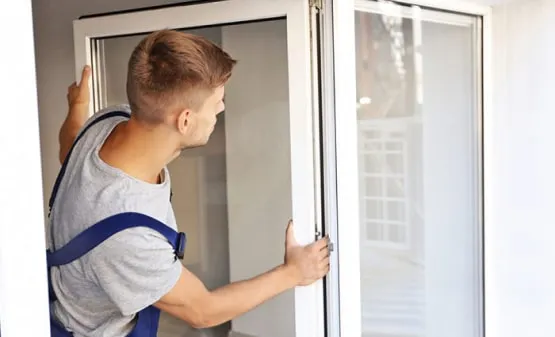

A door that won’t close is one of those Sydney summer rituals. The good news: most swollen doors can be fixed without replacement. The bad news: a few can’t. Here’s how to tell which is which, and what to do.
Why doors swell or stick
It’s rarely just one thing. Look for combinations of:
- Moisture and humidity. Sydney’s wet summer gets timber doors absorbing water. Even sealed doors can swell 3–5mm at the leading edge.
- Temperature changes. Hot afternoon sun on a west-facing door expands the timber unevenly.
- Installation tolerances. A door fitted with very tight tolerances (1–2mm gap) will jam at the first humidity spike. Properly fitted doors leave 3mm gaps.
- Poor ventilation. Bathroom doors and laundries that don’t ventilate well swell first.
- Heat sources. Heaters or radiators directly on a door distort it.
- Structural settling. The house moves over time. The door frame goes out of square – the door binds at one corner.
Note: aluminium doors don’t swell – but their frames can shift and their hinges can drop.
Diagnosing the problem
Six steps to identify the actual fault:
- Inspect the rubbing points. Close the door slowly, look for where the leading edge contacts the frame. Top, bottom, latch side?
- Look for visual clues. Discoloured or stripped paint at the rubbing point indicates regular contact. Dark splotches at the bottom indicate moisture wicking.
- Check hinge alignment and screw integrity. Loose screws on the top hinge cause the door to drop and bind at the bottom-latch corner. Probably the most common single cause we see.
- Assess the strike plate & latch. Sometimes the door isn’t swollen – the strike plate is misaligned. The door catches before the latch reaches the strike.
- Remove the door for test fit. Lift the door off, place it flat, see if it’s warped (sight along the edges).
- Consider environmental factors. Has the room’s humidity changed? Was the door painted recently (sealed properly)? Has the house had any structural movement?
DIY fixes – what you can try
1. Tighten the hinge screws first
This fixes maybe 40% of “swollen” doors. The top hinge takes the brunt of the load – when it loosens, the door drops and binds. Replace short hinge screws with 75mm screws that go into the frame stud, not just the jamb.
2. Sanding or planing
Identify the rubbing point precisely. Mark it with a pencil while closing slowly. Plane down 1–2mm from the leading edge in that area only – don’t take the door down and plane the whole edge.
3. Refinishing or sealing
A door that’s swelling cyclically with seasons is unsealed at the edges or top/bottom. Re-stain or paint the bare timber, particularly the top and bottom edges.
4. Adjusting the strike plate
If the door catches before the latch reaches the strike plate, file the strike plate hole longer or move the strike plate up/down by a few mm.
5. Controlling humidity / ventilation
40–60% indoor humidity is the timber-friendly range. Dehumidifier in damp rooms, extractor fans on in bathrooms, doors left ajar to ventilate.
DIY limit: if planing more than 4mm is required, or the door is visibly warped (look along the long edge), you’re past DIY and into replacement territory.
Professional repair & replacement options
- Precision trimming and reshaping. A professional plane removes timber evenly without rounding the edge. Re-bevel the latch side at 3°.
- Frame realignment or repair. When the frame is the problem, we can re-square and re-pack. Sometimes the architrave needs to come off.
- Hinge adjustments and reinforcement. Move to longer 75mm screws into the studs. Add a third hinge if the door is heavy and only has two.
- Strike plate & latch modifications. Re-locate the strike plate, file the hole, replace a worn latch.
- Door replacement. When the door is past saving, we replace. Aluminium is the most popular choice – won’t swell, low maintenance, modern compliance.
- Protective sealing and finishing. Re-seal the timber properly, paint the top and bottom edges (commonly missed), apply weather-strip.
Preventing swelling & recurrence
- 40–60% indoor humidity – keep it in range with extractors and dehumidifiers
- Annual seal/paint inspection – particularly top and bottom edges
- Re-seal weather-strip every 5 years
- Tighten hinge screws annually as part of general maintenance
- Use 75mm hinge screws that reach the studs – not the short ones they ship with
- Install moisture barriers under doors in damp areas (bathroom, laundry)
Cost considerations & value
Approximate Sydney pricing, supplied and installed where applicable:
- Hinge tighten & minor adjustment service: $150–$250
- Plane & refit: $250–$450
- Strike plate & latch replacement: $180–$350
- Frame re-square & repair: $400–$900
- Aluminium hinged door replacement (residential): $1,800–$4,500 supplied and installed
- Architectural door replacement: $4,500+
When in doubt, call
A 30-minute on-site assessment usually tells you whether it’s a $200 fix or a $3,000 replacement. We do that visit free. 1300 854 726.